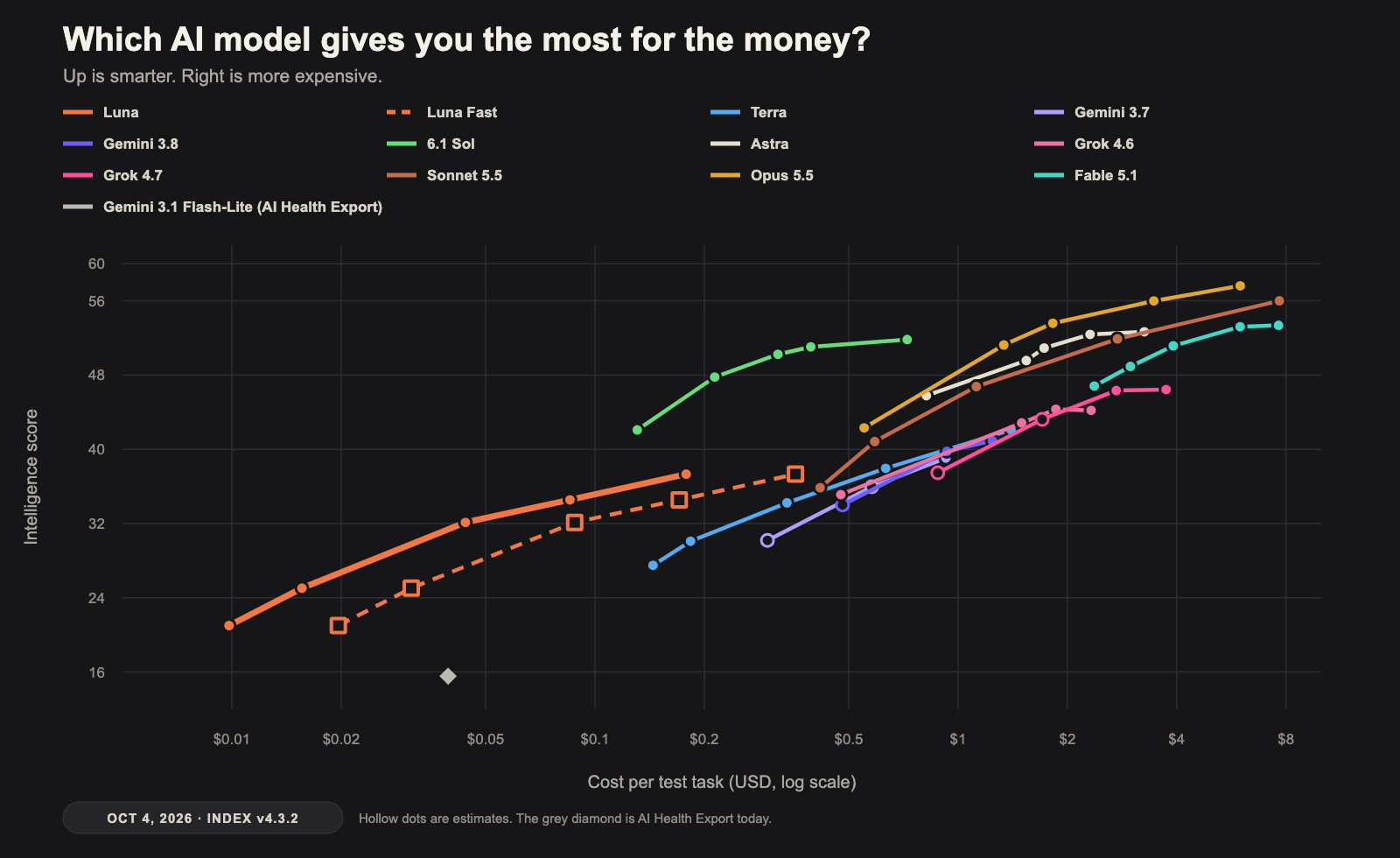
Updated October 4: Almost as smart. Way cheaper. The green line is now GPT-6.1 Sol. Max scores 51.8 at about $0.72, about one point under Astra and less than a quarter of Astra's cost. The rust line is now Sonnet 5.5. Its max scores 56.0 at about $7.67, close to the top and priced like the old expensive models. Every other line is still the September 22 measurement on the same test, Intelligence Index v4.3.2. Opus 5.5 still reaches the highest score.
I like this chart because I can understand it in about five seconds. I do not have to read a hundred posts about why one model is supposedly destroying another model this week.
Most connected dots are different amounts of thinking. The higher the dot, the smarter it tested. The farther right it goes, the more it costs.
What I see
Almost as smart. Way cheaper. GPT-6.1 Sol max scores 51.8 for about $0.72. Astra max is 52.7 for about $3.26. About one point less, at less than a quarter of the cost. Opus 5.5 still takes the top, 57.6 at about $5.98. OpenAI is going after the subscription, not just the high score. If that price sticks, expensive starts to look like a choice, not the price of being smart.
Why I retest instead of re-reading
The “40% cheaper” line is a typical-work claim. The token price dropped 20%, from $5 and $25 to $4 and $20 per million. Cache reads dropped from $0.50 to $0.20. Anthropic’s 40% figure is their blend for typical work at the default medium setting. On this test, medium is about 39% cheaper than Opus 5 medium. Max is about 2% more expensive than Opus 5 max, because it thinks longer.
That is the practical argument for keeping operations model agnostic. If switching models is a config change instead of a rewrite, a pricing special turns into free capacity to get real work done. If it is a rewrite, the special expires before the argument about it finishes. Making the chart is the easy part, using it is the point.
What changed?
On October 4 two lines changed. GPT-6.1 Sol replaces GPT-5.6 Sol, and Sonnet 5.5 replaces Sonnet 5. Looking at the chart, Sol moved up and to the left. Strong scores showed up under a dollar. The other September 22 lines stay, including the Gemini the app still runs. Hollow dots are thinking levels a vendor offers when the measured cost was missing or copied from another model. Sonnet 5.5 climbed too, but its max still costs about $7.67, more than Opus 5.5 max.
I also made the chart interactive. Hover over a model to bring its line forward. Click one to keep it highlighted while you look at the details.
The one gray Gemini 3.1 Flash-Lite dot stays because it gives me a useful comparison for AI Health Export.
Want to see the methodology?
Where these numbers come from, what counts as measured versus estimated, and a running log of what changed on every update, including the one where a model's cost moved 12% with no price change behind it. How the model chart is built →
Why am I looking at this?
I am thinking about Luna and Gemini for AI Health Export after version 3.0. I am not changing anything yet. I just want to live with the tradeoff for a while and see what starts to make sense.
Technically, I am already using Luna in one real place: Hermes, my personal AI agent. That is part of why I keep looking at it.
The chart does not need to answer everything. Later, I can try both models inside the real app and see which one feels faster and gives better answers. For now, this gets me 90% of the way there.
The bigger idea
I never want a project trapped inside one AI model, whether it is an app, a website, an internal tool, or something I am building for a client. So I keep the important parts in a set of mostly Markdown documents: the project history, decisions, instructions, rules, and step-by-step playbooks that any AI agent can read. That is the basic idea behind AgentOps, a system I built to keep my work organized and portable. Claude, GPT, Gemini, or whatever comes next can pick up those same documents and understand how the project works. If something better comes along, I can switch models without starting over. I think everyone doing serious work with AI should build some version of this.
If your own AI setup feels more confusing than helpful, that is exactly the kind of mess I like untangling.